
The Complete Guide to Cosmetic Spray Bottles: Fine Mist vs Trigger


Most spray decisions start at the bottle and should start at the head. A brand finds a bottle shape it likes, orders a sprayer that screws onto the neck, and only discovers after the first production run that the toner comes out in wet blobs, the setting spray disrupts foundation, or the head jams on an oil-rich mist by week three. The bottle was never the first question. The dispensing mechanism was.
A spray bottle is really two products bought together: a container and a pump. The container decides how the product looks and what it costs to ship. The pump decides how the product feels in the hand, how much comes out, how fine the mist is, and whether the formula survives contact with the parts it flows through. Get the pump wrong and no amount of nice glass will save the launch.
So the useful way to read this is by mechanism first. Cosmetic spray bottles split into a handful of head types, and the gap between a fine mist and a trigger is not a small one. This guide walks through what each mechanism actually does, which products belong on which head, where formulas quietly wreck a sprayer, and what to specify in the RFQ so the quotes coming back are comparable.
Why the head is the first decision, not the bottle
Three things about a sprayer are set by the head, not the bottle, and all three are hard to change after tooling.
Output per stroke. How much product leaves the nozzle each press. A facial mist wants a whisper; a salon treatment spray wants coverage. The difference between them is roughly an order of magnitude, and it is fixed by the pump, not the bottle size.
Droplet size. How finely the liquid is atomised. This is what separates a soft, even veil from a wet, uneven splat. It is governed by the orifice insert and chamber pressure inside the head.
Wetted parts. The dip tube, gasket, spring, valve and orifice that your formula actually touches. This is where compatibility lives, and it is invisible on a photo of the finished bottle.
None of this is visible when you approve a sample on aesthetics alone. It is also the part that comes back to bite a launch, so it belongs at the top of the brief. If you are still deciding between spraying, dropping and pumping the product at all, our comparison of dropper, pump and airless formats covers that upstream choice; this guide assumes you have landed on spray and now need the right head.
Fine mist sprayers: the default for face and premium personal care
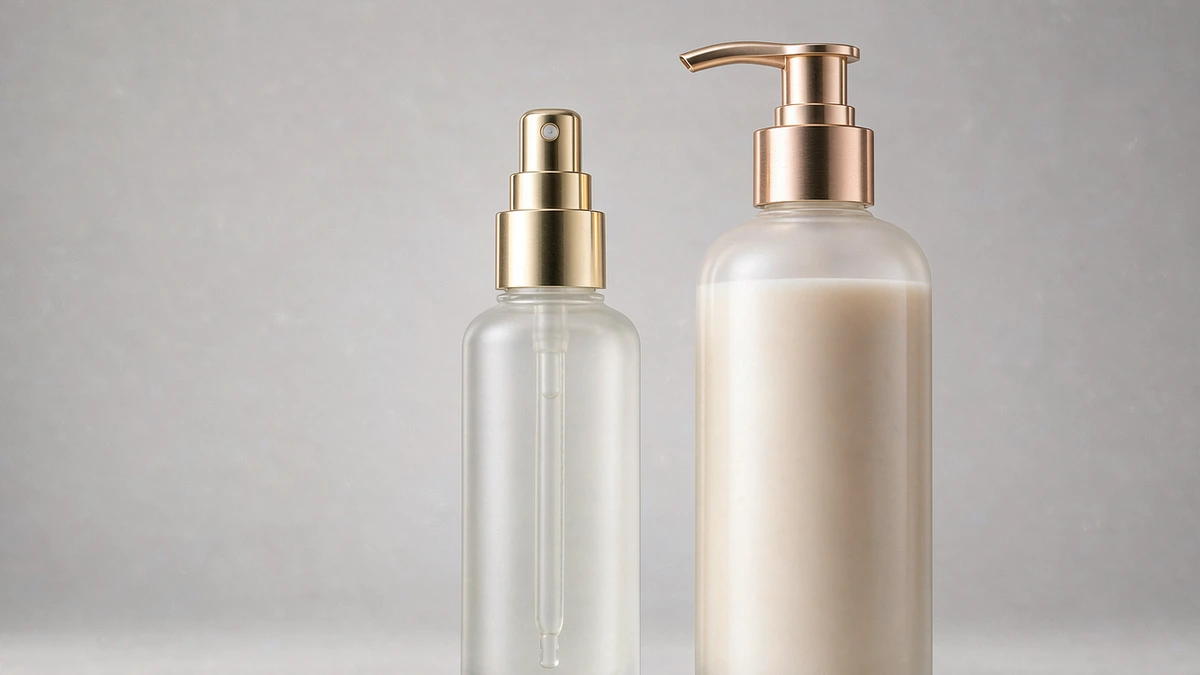
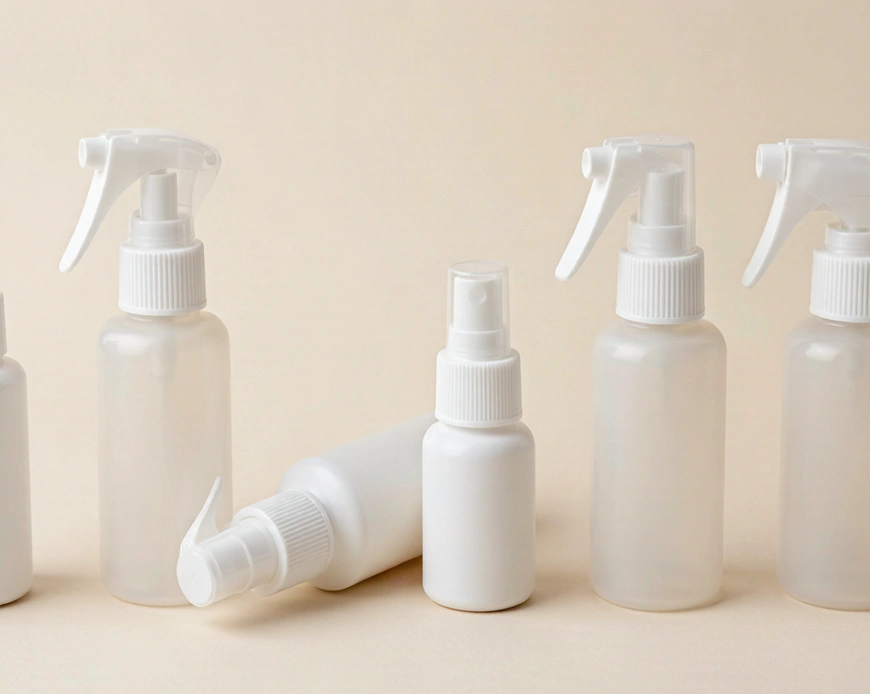
A fine mist sprayer is the top-push atomiser you see on toners, essences, setting sprays, facial and body mists, and most perfumes. Press the actuator and a small orifice breaks the liquid into fine droplets that settle as an even film. Output per stroke is low, the actuation force is gentle, and the form factor is slim and vertical, which is why it reads as premium on a vanity or a retail shelf.
It is engineered for water-thin liquids. The classic complaint, “it does not feel fine enough, it feels wet,” is almost always an orifice mismatch rather than a formula problem, so for a facial product it is worth specifying a tight orifice and asking the supplier for a droplet-size report rather than trusting a photo. Reported droplet and output figures vary widely between suppliers and orifice grades, so treat any single number as a starting point and confirm it against your own formula.
Fine mist earns its place anywhere the application has to feel effortless and invisible: face, premium body, fragrance. Where it struggles is anything thick, oily, particle-laden or waxy, because a narrow orifice clogs. If your product is a facial toner, a hydrating mist or a setting spray, this is almost certainly your head.

Trigger and mini-trigger sprayers: coverage over refinement
A trigger sprayer swaps the top-push actuator for a pistol-grip lever. That lever generates more force, so a trigger handles thicker liquids and pushes out far more product per pull, with larger droplets and usually an adjustable nozzle that switches between stream, spray and off. The trade-off is that it is larger, heavier, needs a firmer pull, and reads as functional rather than luxurious. That is why triggers dominate household, garden and professional-use products and rarely appear on prestige beauty.
In cosmetics, the trigger’s home is large-area and professional application: salon hair treatments, tanning products, body sprays applied over a wide area, and room or linen mists sold alongside a beauty range. The mini trigger is the useful hybrid. It keeps a lever grip but in a compact, cosmetic-friendly size with a finer output, which suits hair refreshers, travel formats and boutique home fragrance where a full-size household trigger would look wrong.
If the job is covering a large surface quickly, or the formula is too viscous for a fine orifice, the trigger family is the honest answer even when it is less glamorous.
Continuous mist and treatment pumps: the middle ground
Two other heads sit between the extremes and are worth knowing before you commit.
A continuous mist sprayer uses a pre-compression mechanism that keeps spraying for as long as you hold the actuator, instead of one burst per press. The droplets tend to be finer and the spray longer, which creates an enveloping, cloud-like application. It costs more than a standard pump and is positioned for premium hydrating mists and luxury fragrance, and it is often pitched as a recyclable alternative to aerosol.
A treatment or regular mist pump sits between fine mist and trigger on both droplet size and output. It tolerates slightly thicker liquids than a fine mist and is common on hair and styling products that need a wetter, more targeted application than a facial mist but do not warrant a trigger.
Neither is exotic, but naming them in the brief stops the supplier from defaulting to a plain fine mist when a continuous or treatment head is the better fit.
Matching the mechanism to the product
Formula and application usually pick the head between them. Use this as a starting position for your RFQ, not a substitute for testing.
| Product | First choice | Workable | Avoid without testing |
|---|---|---|---|
| Facial toner, essence, hydrating mist | Fine mist | Continuous mist | Trigger |
| Setting spray, makeup fixative | Fine mist (finest orifice) | Continuous mist | Trigger |
| Perfume, eau de parfum | Fine mist / perfume pump | Mini trigger | Standard trigger |
| Body mist | Fine mist | Continuous mist, mini trigger | Standard trigger |
| Hair mist, leave-in, refresher | Fine mist or treatment pump | Mini trigger | — |
| Salon hair treatment, large-area body | Trigger or mini trigger | Treatment pump | Fine mist |
| Oil or two-phase mist | Treatment pump (larger orifice) | Trigger | Fine mist (clog risk) |
| Vitamin C or retinol mist | Airless fine mist | Fine mist, opaque | Any air-inlet head |
| Room, linen or home fragrance spray | Trigger or mini trigger | Continuous mist | — |
The vitamin C and retinol row is the one that catches brands out. A standard dip-tube sprayer draws air into the bottle on every stroke, which is exactly what oxidation-sensitive actives do not want. If that is your formula, an airless mist or an opaque bottle does more for shelf life than the mist quality ever will.
Formula compatibility: what quietly wrecks a sprayer
The parts your formula touches decide whether the sprayer survives to the end of the bottle. Three formula types account for most failures.
High-alcohol formulas (perfumes and many setting sprays, especially above about 70% ethanol) can corrode low-grade internal springs and swell cheap plastics over months. Specify stainless-steel internals and confirm every wetted component (dip tube, gasket, piston, spring, valve) is rated for your alcohol level, and keep the bottle in PET or PP rather than ABS.
Oil, emulsion and two-phase formulas are harder to atomise and more likely to clog a fine orifice. They usually need a larger orifice, an oil-compatible gasket such as silicone or Viton, and a “shake before use” instruction if the phases separate.
Suspended particles, waxes and high-viscosity polymers block narrow orifices outright. If your formula carries exfoliant particles, pigments or a thickener, a fine mist is the wrong head, and even a treatment pump needs testing.
None of this can be judged from a spec sheet. It has to be run, and it is cheaper to run before tooling than after a recall. Our guide to compatibility and stability testing sets out what to test and for how long.
The bottle still matters: material and neck finish
Once the head is chosen, the bottle decisions are the same ones that apply to any cosmetic container, and we have covered them in depth elsewhere rather than repeating them here.
Material follows the usual logic: glass for premium, inert and light-sensitive formulas, with amber or opaque coating where UV protection matters; PET for glass-like clarity at plastic weight; PP or HDPE for lightweight, travel and budget-friendly lines. The amber versus clear glass question and the broader glass versus plastic trade-off both carry straight over to spray bottles.
Neck finish is the detail that trips up first-time buyers. The sprayer and the bottle have to share a thread, and cosmetic sprayers cluster around a handful of finishes, roughly 15–18 mm for travel and perfume formats, 20/410 for face-mist sizes, 24/410 for body and hair, and 28 mm for household triggers. Quote the finish explicitly so the head and bottle actually mate; our explainer on cosmetic bottle neck sizes shows how the numbers work. Actuator and closure decoration — colour-match, silkscreen, hot stamping or an aluminium overshell — is where a technical part starts doing brand work.
What to put in the RFQ so the quotes are comparable
Quotes for “a spray bottle” come back non-comparable almost every time. Specify these and they stop.
- Head type: fine mist, continuous mist, treatment pump, trigger or mini trigger
- Target output per stroke, and the droplet size or orifice diameter you expect
- Bottle capacity, and whether you mean fill volume or brimful volume
- Neck finish and thread size, stated explicitly
- Bottle material and, for glass, colour and any coating
- Wetted-parts materials: dip tube, gasket, spring, valve, orifice insert
- Formula type, viscosity and alcohol content, so compatibility can be checked
- Lock or overcap requirement for travel and leak prevention
- Dip-tube length relative to bottle height
- Decoration method and colour targets
- Any compatibility, spray-pattern or leak-test data the supplier already holds
- Quantity tiers, so the price break structure is visible
The last point matters more than it looks. Quantity changes which heads and bottles are even available to you, because stock components and custom tooling have very different entry points. If that is unfamiliar territory, our explainer on how packaging MOQs work covers why the same spray bottle can carry three different minimums.
Need help choosing the right spray bottle?
Tell us your formula, capacity and target price point, and we will come back with sprayer options, neck-finish matching and quantity tiers.
FAQ
What is the difference between a fine mist sprayer and a trigger sprayer?
A fine mist sprayer is a top-push atomiser that releases a small amount of finely broken-up liquid with a gentle press, which suits facial mists, toners, setting sprays and perfumes. A trigger sprayer uses a pistol-grip lever that pushes out much more product per pull in larger droplets, which suits large-area, professional and household use. Fine mist is about refinement; trigger is about coverage.
Which sprayer is best for a facial toner or hydrating mist?
A fine mist sprayer, and for a premium hydrating mist a continuous mist head is worth considering. Both give the light, even, cloud-like application a face product needs. Specify a tight orifice and ask the supplier for a droplet-size report, because the most common toner complaint is a wet mist, and that is usually an orifice mismatch rather than a formula fault.
Can I use a fine mist sprayer for an oil or a formula with particles?
Not without testing, and often not at all. Oils are harder to atomise and can need a larger orifice and an oil-compatible gasket, while suspended particles and waxes block narrow orifices outright. For oil-rich or particle-laden formulas a treatment pump or trigger is usually the safer head, and any choice should be run against your actual formula first.
What sprayer should I use for a vitamin C or retinol spray?
Look at an airless mist system. A standard dip-tube sprayer draws air into the bottle on every stroke, which is exactly what oxidation-sensitive actives like vitamin C and retinol do not want. Pairing an airless mechanism with an opaque or amber bottle protects shelf life far more than mist quality alone.
How do I make sure the sprayer fits my bottle?
Match the neck finish. The sprayer and the bottle must share the same thread, quoted as a number like 20/410 or 24/410. Cosmetic sprayers cluster around 15–18 mm for travel and perfume, 20/410 for face mists, 24/410 for body and hair, and 28 mm for household triggers. State the finish in your RFQ so the head and bottle actually mate.
Are spray bottles recyclable, and what are the sustainable options?
Sprayers are mixed-material by nature, which complicates recycling, but the options are improving. Post-consumer recycled plastic bottles, mono-material sprayer designs that avoid mixed components, and refillable systems are all available, and a continuous mist pump is often positioned as a recyclable alternative to aerosol. State your sustainability target in the brief so the supplier quotes the right construction.