
How to Choose the Right Dropper Bottle for Essential Oils

Essential oils are not ordinary cosmetics. Chemically, they behave more like solvents than like a gentle serum — and that single fact quietly decides whether your packaging protects the product or slowly destroys it. A bottle that looks perfectly fine on the shelf can be dissolving its own dropper bulb, leaching aroma through its cap liner, and bleaching its active compounds under shop lighting, all before the customer ever opens it.
If you are sourcing dropper bottles for an essential-oil line — whether that is lavender, a citrus blend, a CBD tincture, or a facial oil built around volatile actives — the standard ‘glass bottle + dropper’ assumption will get you into trouble. This guide walks through the four decisions that actually determine shelf life and returns: glass color, the dropper bulb, the seal, and the size-and-neck match. It is written for buyers who need to brief a supplier with confidence, not for chemists.
Why essential oils break ordinary dropper bottles
Two mechanisms do the damage, and they work together.
The first is chemical. Essential oils — especially citrus oils rich in limonene — are natural solvents. Natural-rubber (latex) dropper bulbs are the classic casualty: the oil attacks the polymer chains, the bulb swells, then turns sticky and tar-like within three to six months, contaminating the product. Several suppliers document this exact failure mode, and it is one of the most common avoidable returns in the category.
The second is light. UV radiation in the 290–400 nm range triggers photo-oxidation — free-radical reactions that break down terpenes, linalool, and esters, the very compounds that give an oil its scent and effect. In controlled comparisons, lavender oil stored in clear glass lost roughly 43% of its key aromatic compound (linalool) over twelve weeks, while amber glass retained about 92%. Four to eight weeks of bright retail display can measurably degrade a sensitive oil.
So a ‘glass bottle’ is necessary but nowhere near sufficient. The color of the glass and the material of the closure decide the outcome.
Start with glass color — amber is the default
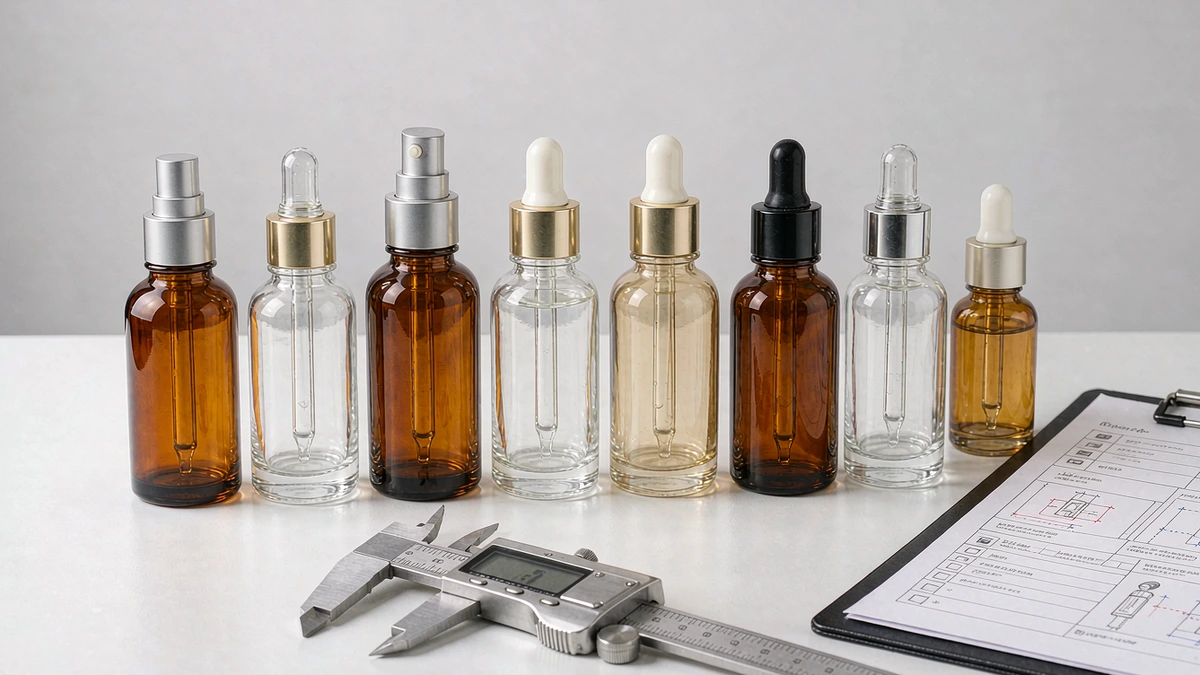
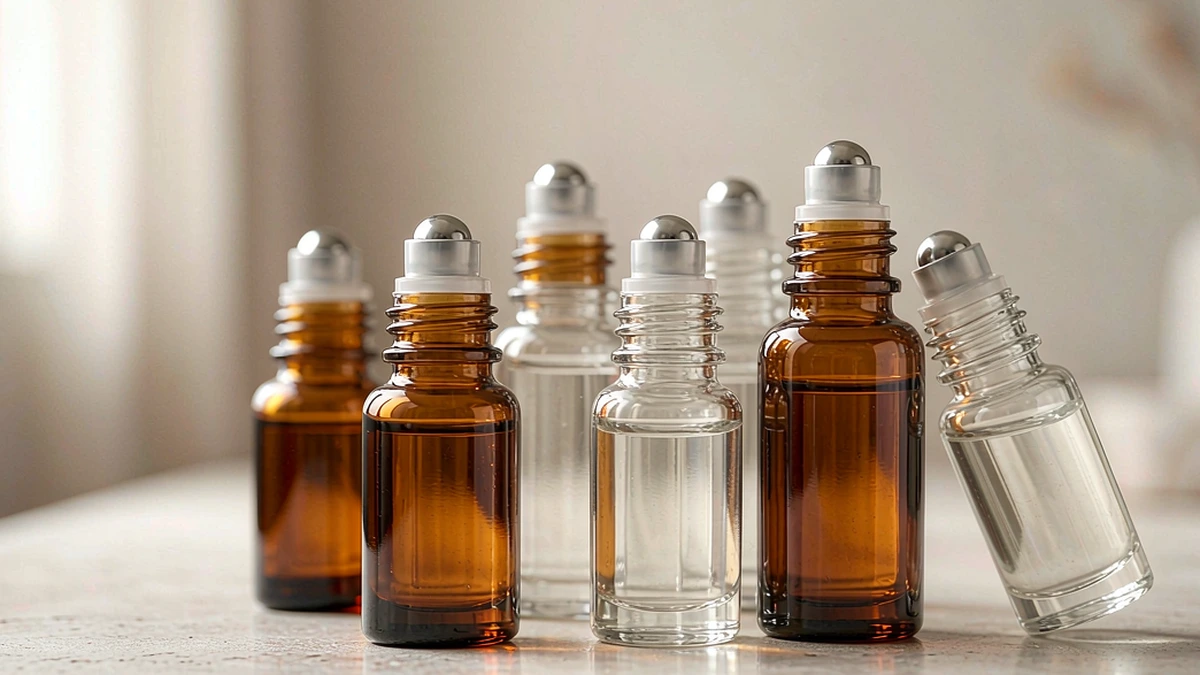
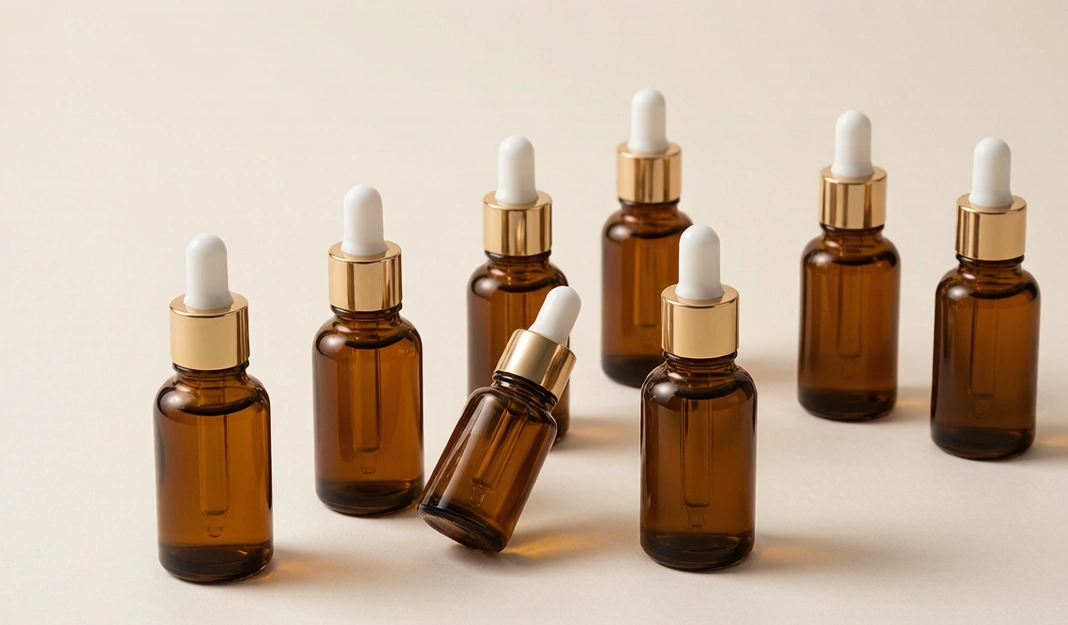
Amber soda-lime (Type III) glass blocks roughly 90–98% of UV across the damaging 290–450 nm band. That is why it is the category standard for essential oils. For most formulations — lavender, tea tree, peppermint, eucalyptus — standard amber is more than adequate.
The other colors are tradeoffs, not equivalents:
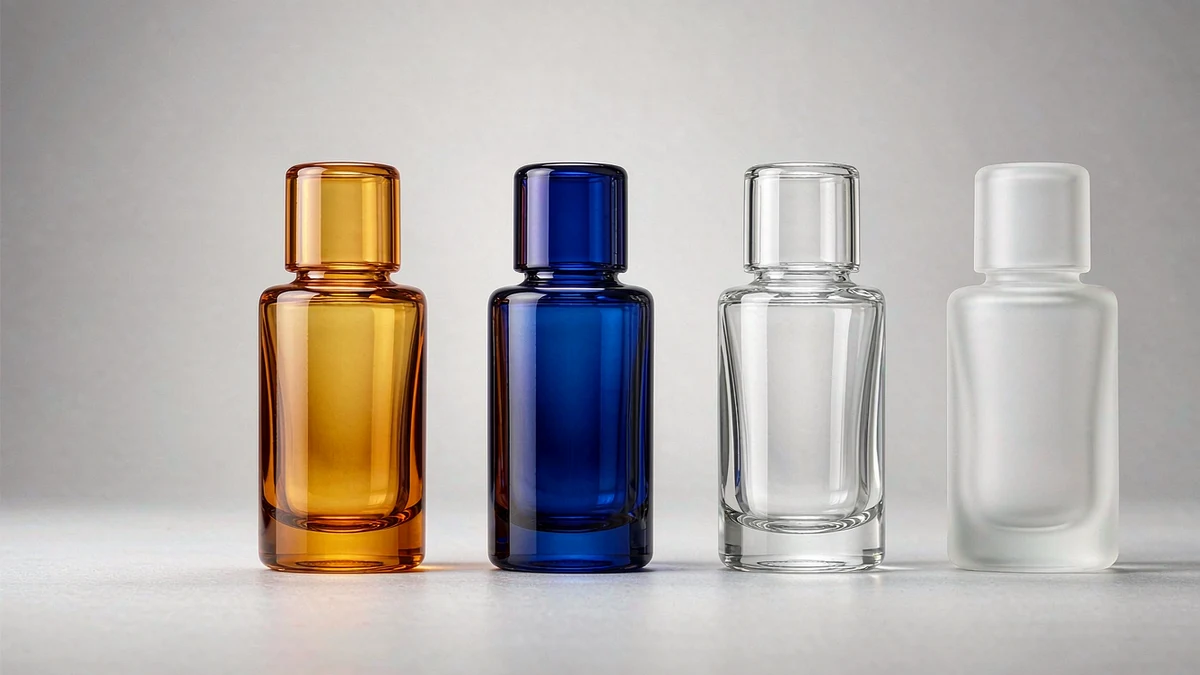
- Cobalt blue blocks about 75–80% of UV. It is acceptable for less volatile oils with high turnover (peppermint, tea tree, eucalyptus) kept cool and dark, but it leaves a real gap for citrus, floral, or resin oils held for twelve months or more. It also photographs beautifully, which is why brands choose it for gift and spa lines — usually paired with an opaque outer box or sleeve.
- Green sits around 50–60% UV blockage. Decorative and short-term only.
- Clear gives 10–15% blockage. Display piece, not storage.
One refinement worth knowing: for low-pH citrus oils (lemon, bergamot, grapefruit, pH 3–4), a Type II surface-treated amber glass prevents trace sodium leaching over long storage. Type I borosilicate is technically superior but is overkill for roughly 99% of essential-oil applications and adds cost without shelf-life benefit. If you want the deeper dive on color tradeoffs, our guide on amber vs clear glass bottles covers it in detail.
Glass also wins on permeability: amber glass has an oxygen transmission rate near zero compared with plastics, which prevents the oxidative rancidity that ruins lipid-rich oils such as rosehip or marula.
The most important line on your specification sheet is the bulb material
It is the component in closest, longest contact with the oil, and it fails more often than the bottle does.
- Natural rubber (latex): dissolves within three to six months in essential-oil contact. Avoid entirely for this category.
- TPE: workable for general use but hardens and loses elasticity over time.
- Nitrile (NBR): excellent resistance to oils and acids; the industrial standard for reagents. Fine for products where the bulb does not sit in the liquid for extended periods.
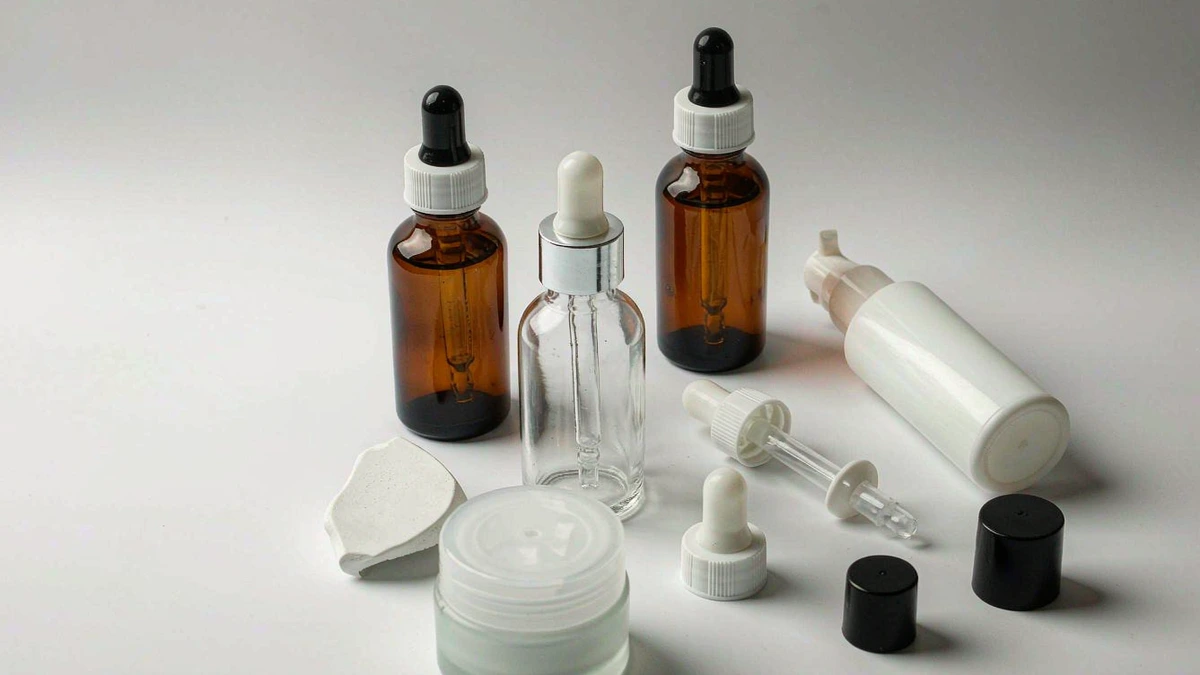
- Platinum-cured silicone: inert, skin-contact safe, no leach. This is the gold-standard specification for essential-oil droppers. Its one quirk is that it is slightly gas-permeable, so very volatile alcohol-based formulas may evaporate slowly through the bulb — manageable with a good liner and proper fill level.
The price gap is tiny and the downside is large. A natural-rubber bulb might cost two cents; a platinum-cured silicone bulb eight cents. That six-cent difference prevents a return that costs eight to fifteen dollars and a lost customer. For any oil retailing above roughly ten dollars, specify ‘silicone, platinum-cured, Shore A 50–55.’
We have a full silicone vs rubber dropper bulb comparison if you want the material data side by side.
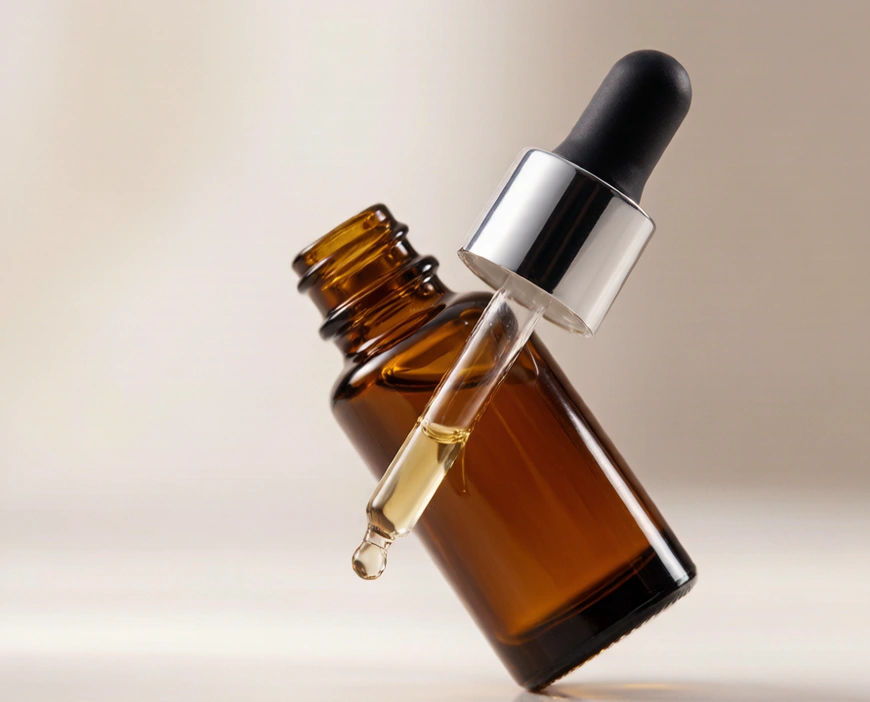
Closing the evaporation gap: pipette, insert, cap, liner
The bottle and bulb get the attention, but the seal around them is where ‘top notes’ quietly escape.
- Pipette (glass tube): use borosilicate (Type I) or soda-lime (Type III) glass. A plastic pipette clouds and leaches plasticizers under oil solvent action.
- Orifice insert: glass or PP. Rubber or unlined PE swells, drips, and delivers an inconsistent dose.
- Cap: PP, urea (thermoset), or aluminum with a PE liner. Polystyrene cracks on contact; ABS stress-cracks from vapor.
- Liner: PTFE-faced, aluminum-faced PE, or silicone liners stop vapor permeation. Standard PE foam lets the product lose 2–5% of its weight per year to evaporation.
For household essential oils, a child-resistant (CRC) dropper cap is worth specifying. And if your formula is thick — a castor-and-argan beard oil, a viscous serum blend — the pipette tip aperture matters as much as the bulb. A thin-liquid pharmaceutical tip (around 0.9 mm) will choke on a thick oil; a wider straight tip (around 2.5 mm) lets it flow by gravity. An LDPE wiper insert inside the neck strips excess oil off the pipette on the way out, which is what turns ‘messy drip down the side’ into a clean dose. These are formula-dependent, so they belong on your sample-test checklist, not your assumptions.
Sizing and neck finish by use case
Size and neck finish have to match both the product and the closure. The industry standard neck for essential-oil droppers is DIN18 / 18/415, and rim planarity is what keeps the seal tight — a sloppy neck finish is why cheap caps loosen in transit and leak.
| Capacity | Overflow | Typical fill | Common neck finish | Typical use |
|---|---|---|---|---|
| 5 ml | 6–7 ml | 4.5–5 ml | 13/400, 15/400 | samples, travel, high-value singles |
| 10 ml | 12–14 ml | 9–10 ml | 18/400, 18/410 | standard retail |
| 15 ml | 17–20 ml | 13–15 ml | 18/400, 20/400 | premium, gift sets |
| 30 ml | 35–38 ml | 28–30 ml | 18/400, 20/410 | bulk, practitioner |
| 50 ml | 58–62 ml | 48–50 ml | 20/410, 24/410 | wholesale |
| 100 ml | — | — | 24/410 | spa, DIY refill |
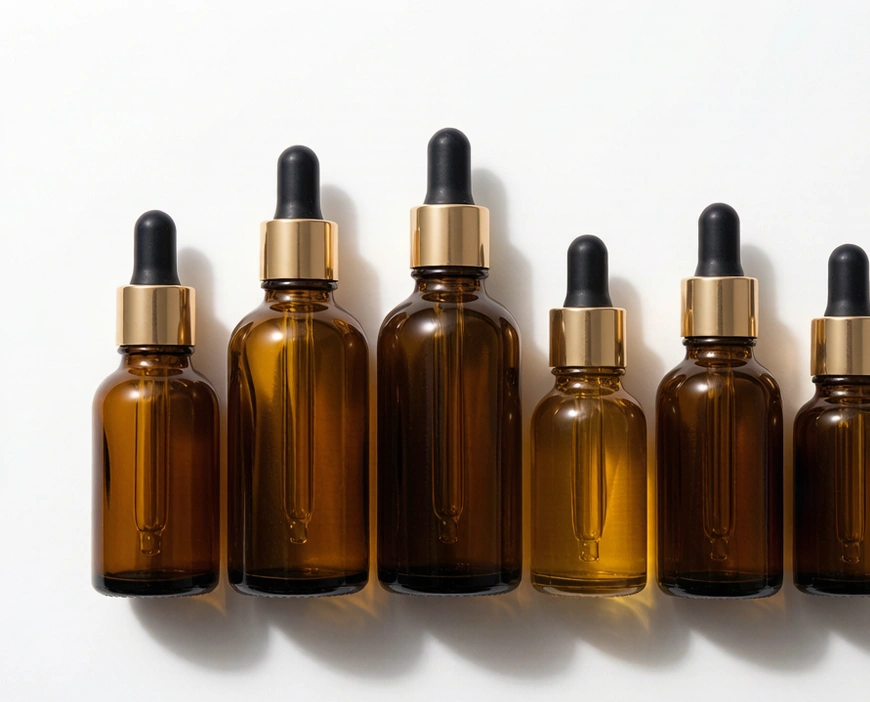
A few rules of thumb: leave 10–15% headspace to limit oxygen exposure, and store filled bottles upright at 15–20°C. If you are still narrowing down capacity, our dropper bottle sizes guide lays out the tradeoffs, and the cosmetic bottle neck sizes explainer is the place to confirm a cap will actually thread on.
One broader question worth settling early: do you even want a dropper, or would a pump or airless bottle suit the formula better? That depends on viscosity, dose size, and oxidation risk — the dropper vs pump vs airless comparison helps you decide before you commit to tooling.
A sourcing checklist you can hand your supplier
The packaging is only as good as the supplier’s proof. Before you commit to a bulk order, ask for:
- Bulb material specification in writing — ‘platinum-cured silicone, Shore A 50–55,’ not ‘silicone.’ Confirm it for your specific oil, especially if it is citrus-based.
- Leak and vacuum test reports — negative-pressure and shipping-vibration testing, not just a claim of ‘leak-proof.’
- Sample-first policy — fill the actual bottle with your actual formula and age it. Viscosity, bulb recovery, tip flow, and liner performance are all formula-specific.
- Certifications — ISO 15378 for primary packaging, plus the market-specific marks (FDA, EU cosmetic, REACH, RoHS, EPR) your destination requires.
- Neck-finish confirmation — verify the cap and dropper assembly are matched to the bottle’s exact finish (18/410 vs 18/415 vs 20/410, etc.).
- Decoration and customization — silk-screen, hot-stamping, frosting, and custom collar colors if branding matters to the line.
MOQ, lead time, and which capacities and neck finishes are actually stocked vary by supplier, so confirm those numbers directly rather than assuming. Fill levels, closure choices, and certification scope are exactly the kind of detail that prevents a costly reformulation or a blocked shipment later.
Choosing the right dropper bottle for essential oils is less about picking a pretty vessel and more about engineering a small, sealed chemical system: amber glass against light, silicone against solvent, and a tight liner against air. Get those three right and the product that reaches the customer is the product you meant to ship.
Sourcing Dropper Bottles for Your Essential Oil Line?
Tell us your formula, capacity, and target market — we’ll help you specify the right glass color, bulb material, and seal.
FAQ
Can I use natural rubber dropper bulbs for essential oils?
No. Essential oils — especially citrus oils rich in limonene — dissolve natural rubber within three to six months, leaving the bulb sticky and contaminating the product. Specify platinum-cured silicone or nitrile (NBR) bulbs instead.
Is amber glass necessary, or is cobalt blue enough?
For most essential oils, amber is the safe default: it blocks roughly 90–98% of UV. Cobalt blue blocks about 75–80% and suits only less volatile oils with fast turnover. It is not enough for citrus, floral, or resin oils held for twelve months or more.
What size dropper bottle should I choose?
10 ml is the standard retail size; 5 ml works for samples and travel; 15–30 ml suits premium and practitioner lines; 50–100 ml is for wholesale and refill. Match the neck finish — commonly 18/410 or 18/415 — to your cap.
How do I stop essential oils from evaporating through the cap?
Use a PTFE-faced or silicone cap liner and keep 10–15% headspace. Standard PE foam liners can let a product lose 2–5% of its weight per year to vapor permeation.
Do I need child-resistant caps?
For household essential oils, child-resistant (CRC) dropper caps rated to ISO 8317 are recommended.